
What is Vector Search: The Next Evolution of Search Technology
Vector search is an AI-powered search technology that finds information based on meaning and context rather than exact keyword matches. It converts text, images, audio, and other data into mathematical representations called vectors. When a user searches, the system compares vector similarities to deliver the most relevant results. Unlike traditional keyword-based search, vector search understands user intent, semantic relationships, and contextual meaning.
Vector Search Explained: Enhancing Search Efficiency Through Semantic Understanding
Search technology has undergone a remarkable transformation over the last three decades. In the early days of the internet, search engines relied heavily on exact keyword matching. If a user searched for a specific phrase, the system attempted to locate documents containing those exact words.
While this approach was revolutionary at the time, it often failed to understand context, intent, or meaning. Users had to carefully choose keywords to find relevant information, and even then, search results were frequently inaccurate or incomplete.
The rise of AI Overviews has created a new competitive environment where semantic understanding matters more than exact keyword matching. Businesses that adapt to this reality will gain a significant advantage in AI visibility, while those relying solely on traditional SEO tactics may gradually lose exposure as user behavior shifts toward AI-generated answers.
What Exactly Is a Vector Search?
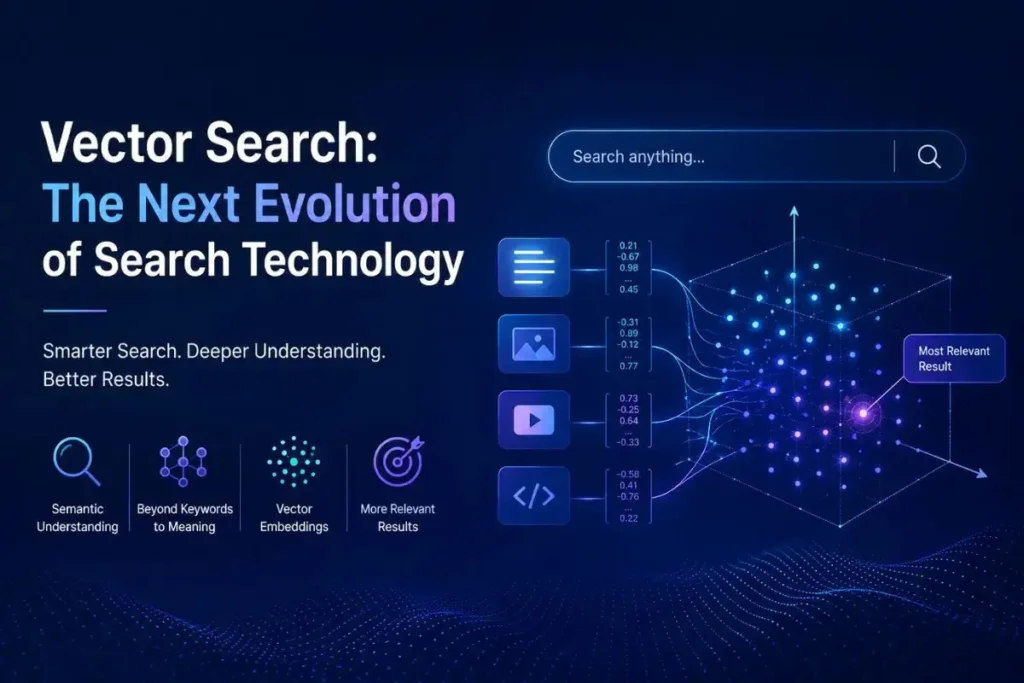
To understand vector search, you first need to understand what a vector is. In simple terms, a vector is a list of numbers representing information mathematically. While this may sound intimidating, the concept is surprisingly straightforward. AI models convert text, images, audio, and videos into numerical representations that capture their meaning.
Think of a vector as a digital fingerprint for content. Just as every fingerprint uniquely identifies a person, every vector uniquely represents a piece of information. Similar concepts produce vectors that appear close together in mathematical space.
Embeddings are special types of vectors generated by machine learning models. These embeddings capture semantic relationships and contextual meaning. Modern AI systems transform enormous amounts of unstructured data into embeddings, enabling machines to understand connections between ideas.
Example
Keyword
Rubbish removal company UK
Rubbish Removal Service UK
rubbish removal service
waste removal service in uk
Junk Removal Service in UK
Vector Format
[0.78,0.69,0.60]
[0.79,0.70,0.61]
[0.80,0.71,0.62]
[0.81,0.72,0.63]
[0.82,0.73,0.64]
Similarity
0.95
0.96
0.97
0.98
0.99
Even though the words are different, the vector numbers are close, which means the google understands the same intent or meaning.
Always understand that there is a lot of mathematics behind every algorithm. As AI evolves, Vector Search is becoming the backbone of intelligent search systems.
How Vector Search Works
The process behind vector search may seem complex, but its underlying concept is surprisingly intuitive. It begins with transforming data into embeddings. Machine learning models such as transformer-based neural networks analyze content and generate numerical representations that capture its meaning. Each document, image, or piece of content becomes a point in a multi-dimensional vector space.
Once the embeddings are generated, they are stored in specialized vector databases. These databases are optimized for similarity searches rather than traditional SQL-style lookups. When a user enters a search query, the same embedding model converts the query into a vector representation. The system then compares this vector against millions or even billions of stored vectors.
Vector Search vs Traditional Keyword Search
Traditional keyword search and vector search differ fundamentally in how they interpret information. Keyword search relies on matching exact terms or phrases found within documents. While effective for precise queries, it struggles with ambiguity, synonyms, and contextual understanding. Vector search, on the other hand, focuses on meaning and semantic relationships
Feature
Context Understanding |
Synonym Recognition |
User Intent Detection |
AI Compatibility |
Multimodal Support |
Relevance Quality |
Traditional Keyword Searching
Limited |
Weak |
Minimal |
Moderate |
Limited |
Variable |
Vector Search
Advanced |
Strong |
High |
Excellent |
Extensive |
Highly Relevant |
Core Technologies Behind Vector Search
Several advanced technologies work together to make vector search possible. At the heart of the system are machine learning models that generate embeddings. Popular transformer architectures such as BERT and modern large language models create numerical representations capable of capturing semantic meaning with remarkable accuracy.
Vector databases provide the infrastructure required to store and retrieve embeddings efficiently. Unlike traditional databases designed for structured records, vector databases specialize in similarity search operations.
Solutions such as vector-enabled platforms have become essential components of AI infrastructure, supporting applications ranging from recommendation engines to enterprise knowledge systems.
How AI Overviews Retrieve Information
Many marketers believe that AI models simply “know” everything because they have been trained on massive amounts of data. But the reality is far more sophisticated.
In reality, most modern AI search systems rely heavily on Retrieval-Augmented Generation (RAG). This architecture allows AI systems to retrieve fresh, relevant information before generating a response.
The process typically works like this:
A user submits a question.
The system interprets the query intent.
Relevant documents are retrieved using vector search.
Retrieved content is ranked by relevance.
The AI generates an answer using those sources.
Think of vector search as a librarian in a massive digital library. The librarian doesn’t simply search for matching words. Instead, it understands the topic, context, and intent behind a question and then retrieves the most relevant resources.
The Connection Between Vector Search and AI Citations
One of the most valuable outcomes of AI visibility is earning citations within AI-generated responses. Citations function similarly to featured snippets in traditional search, except they often carry even greater influence because users see them directly within generated answers.
Vector search plays a major role in determining which sources get cited. AI systems retrieve multiple content pieces, evaluate relevance, compare authority signals, and then select information to include in generated outputs. Sources that align closely with the query intent are more likely to be cited.
Optimizing Content for Vector Search
Traditional SEO often emphasized keyword density and exact-match optimization. In a vector-driven environment, content optimization requires a broader approach focused on meaning and relationships.
Entity-Based SEO
Entities are people, places, organizations, products, concepts, and topics that search engines recognize independently. Modern AI-powered search systems rely heavily on entity relationships to understand content context, relevance, and authority. By implementing Entity SEO, businesses can strengthen topical relevance, improve semantic understanding, and increase visibility in AI-driven search results.
FAQ
Vector Search helps search engines understand content meaning, user intent, and topic relationships. Websites optimized for semantic relevance, entities, and topical authority are more likely to perform well in AI-driven search environments.
Traditional keyword search relies on exact word matching, while Vector Search focuses on semantic understanding. Vector Search can identify relevant content even when the exact search terms are not present on a webpage.
Vector Search delivers more accurate and context-aware results, helping users find relevant information faster. It reduces irrelevant results and better understands conversational and natural language queries.
Artificial Intelligence creates vector embeddings and analyzes relationships between words, concepts, and entities. This enables search systems to understand context, intent, and meaning at a much deeper level.
To optimize for Vector Search, focus on creating comprehensive content, building topical authority, using relevant entities, answering user questions clearly, implementing structured data, and covering topics naturally instead of keyword stuffing.
Conclusion
Vector search has become one of the most important technologies powering modern AI search experiences. It enables AI systems to move beyond simple keyword matching and understand the true meaning behind user queries and content. As AI Overviews, conversational search, and large language models continue reshaping how information is discovered, semantic retrieval will play an increasingly critical role in determining online visibility.
Organizations that focus on topical authority, entity optimization, semantic depth, and user intent will be better positioned to appear in AI-generated answers. The goal is no longer just ranking on search engines. The goal is to become a trusted source that AI systems retrieve, understand, and cite.
For businesses seeking to improve their online presence, working with an experienced SEO expert in Kerala can help develop content strategies that align with both traditional search engine optimization and emerging AI-driven search technologies.
In the era of AI-driven discovery, vector search is not merely a technical innovation—it is the foundation of digital visibility.

Sarith Udhaya is a Google, Hubspot, SEMrush, and Bing-certified Freelance SEO Expert based in Calicut, Kerala. He has mastered creating successful SEO marketing strategies for all types of businesses using his 6+ years of experience in digital marketing.
From SEO and Google Ads to YouTube optimization and complete digital marketing, Sarith Udhaya works closely with clients to understand their goals and achieve sustainable growth.
His broad industry knowledge, receptiveness, and relentless commitment to outcomes have earned him clients’ trust throughout Kerala. He has helped countless businesses find their digital voice, ensuring they rank well, attract the right customers, and grow steadily. Sarith Udhaya approach is simple – understand your story, translate it into a digital strategy, and ensure the world finds you online.
Unlock Smarter Search Experiences Today
Explore the power of Vector Search and learn how AI-driven search is reshaping the way people find information online.