
Mastering AI Search Optimization: SEO, AEO, GEO, and the Science Behind LLMs
AI Search Optimization (AISO) is the process of making your website and content easy for AI-powered search engines and generative AI platforms to understand, evaluate, and cite in their responses.
By combining semantic SEO, topical authority, structured data, and trustworthy content, AISO helps increase your visibility in AI-generated answers rather than relying solely on traditional search rankings.
Unlike traditional SEO, which focuses on ranking web pages in search engine results, AI Search Optimization aims to make your content the preferred source for AI-generated answers.
What is SEO, AEO, GEO
SEO , AEO, and GEO are digital optimization strategies designed to improve online visibility across different search platforms.
SEO focuses on optimizing websites and content to rank higher in traditional search engines like Google and Bing by using keywords,
AEO focuses on optimizing content to provide direct, accurate answers for answer engines. GEO is the process of optimizing content for generative AI platforms and Large Language Models (LLMs), such as ChatGPT, Gemini, and AI-powered search engines, ensuring that content can be discovered, understood, cited, and recommended in AI-generated responses.
Exploring the Technology Behind SEO, AEO, and GEO: A Guide to LLMs
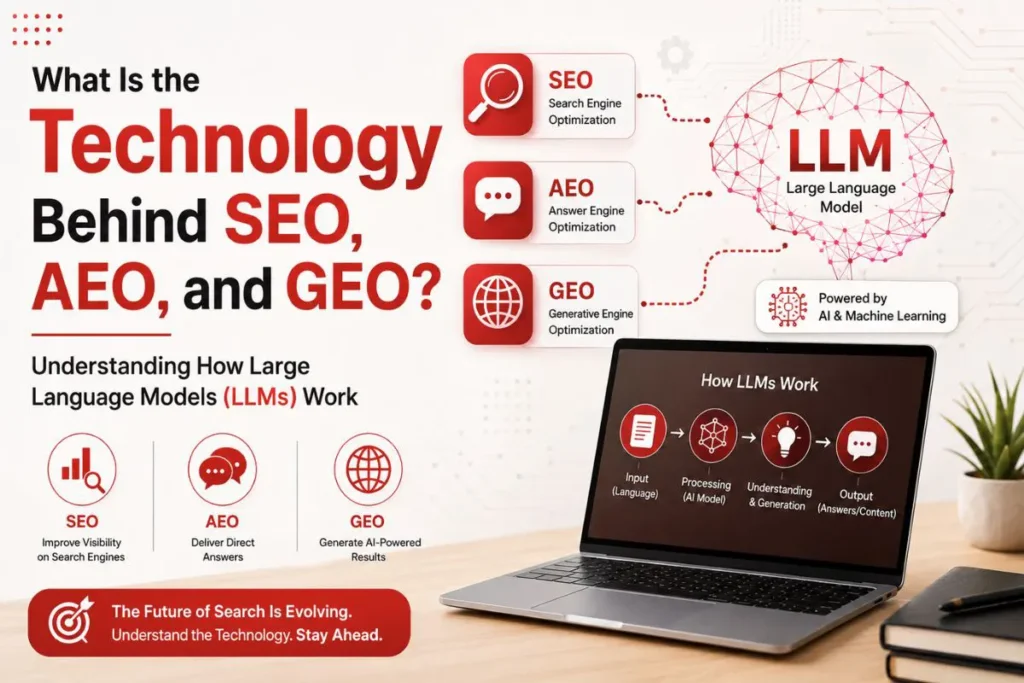
The way people search for information has changed dramatically over the last few years. Traditional search engines like Google once focused on displaying a list of relevant web pages based on keywords and ranking algorithms. Today, AI-powered platforms such as Google AI Overviews, Gemini, ChatGPT, Claude, Perplexity, and Microsoft Copilot can understand complex questions and generate complete answers instead of simply listing links.
This shift has introduced three important digital marketing strategies: Search Engine Optimization (SEO), Answer Engine Optimization (AEO), and Generative Engine Optimization (GEO). Although these strategies have different goals, they all rely on advanced technologies to understand content, interpret user intent, and deliver the best possible results.
The Technology Behind SEO
SEO is not just about writing content or adding keywords. It is a complex ecosystem of technologies working together behind the scenes. At its core, SEO relies on how search engines crawl, index, and rank information across the web. These systems are powered by algorithms that evaluate relevance, authority, and user experience.
Search engines like Google use automated bots to scan websites and understand their structure. Once the data is collected, it is stored in massive databases where ranking algorithms decide which pages should appear for a query. This entire pipeline is what we call the SEO technology stack.
Crawlers are automated programs that continuously scan the internet. They discover new pages, follow links, and collect information. Once this data is gathered, indexers organize it into a structured format that search engines can quickly retrieve.
Think of crawlers as librarians collecting books and indexers as the system that organizes those books in a giant digital library. Without this system, search engines would not be able to deliver relevant results in milliseconds.
Ranking Algorithms
When a user searches for information, Google’s ranking algorithms evaluate many signals, including:
- Content relevance
- Keyword usage
- Backlinks
- User experience
- Core Web Vitals
- Mobile friendliness
- Freshness of content
The algorithm determines which pages best satisfy the user’s search intent.
AEO Explained (Answer Engine Optimization)
AEO is the next evolution of SEO. Instead of optimizing for search rankings alone, AEO focuses on optimizing content to be selected as a direct answer by search engines and AI systems.
It requires content to be clear, concise, and highly structured. It must answer questions directly, often in conversational language. Unlike traditional SEO, where long-form content dominates, AEO values precision and clarity.
This shift is driven by user behavior. People want instant answers, especially on mobile devices and voice search platforms. As a result, optimizing for AEO means understanding user intent more deeply and structuring content so that AI systems can easily interpret it.
How AEO (Generative Engine Optimization) Works
- User asks a question
- Content is broken into meanings
- Content is matched with trusted sources
- AI generates a final answer
10 Essential Answer Engine Optimization (AEO) Factors for AI Search Success
- Search Intent
- Direct Answer First
- High-Quality Content
- E-E-A-T
- Semantic SEO
- Entity Optimization
- Structured Content
- Question-and-Answer Format
- Topical Authority
- Schema Markup
GEO Explained (Generative Engine Optimization)
GEO (Generative Engine Optimization) is the practice of optimizing content for AI-powered search systems that use large language models, semantic retrieval, and ranking signals to generate direct answers instead of listing web pages.
Unlike traditional search engines, generative engines do not just show links. They synthesize information from multiple sources and create a single, coherent response. This means your content must be structured in a way that AI systems can understand, trust, and reuse.
How GEO (Generative Engine Optimization) Works
Content is Crawled and Collected
Search engines and AI systems collect content from websites using crawlers. This data is stored in large indexes.
Content is Converted into Meaning (Embeddings)
The text is transformed into vector embeddings using AI models.
These embeddings represent the meaning of the content, not just keywords.
AI Uses Semantic Search to Retrieve Relevant Information
When a user asks a question, the system:
Converts the query into embeddings
matches it with the most relevant content chunks
retrieves the best passages (not full pages)
This is called semantic retrieval.
Retrieval-Augmented Generation (RAG) Builds the Answer
The retrieved content is passed into a Retrieval-Augmented Generation (RAG) system.
Content is Selected for AI Answers (Not Just Ranked)
Instead of ranking 10 blue links, GEO decides:
Which content is trusted
Which content is most useful
Which content should be included in the AI-generated response
Simple Summary
GEO works like this:
👉 Crawl content → Convert to meaning (embeddings) → Retrieve relevant passages → LLM generates answer → Content appears in AI responses
10 Essential Generative Engine Optimization (GEO) Factors
- Topical Authority
- EEAT
- Answer-First Content
- Semantic SEO & Entity Optimization
- Comprehensive Topic Coverage
- Question-Based Content
- High Information Gain
- Content Structure & Readability
- Schema Markup
- Content Freshness
SEO vs AEO vs GEO: Technology Comparison
SEO
Web Crawlers |
Search Index |
Ranking Algorithms |
Backlinks |
Keywords |
Technical SEO |
AEO
Large Language Models |
Natural Language Processing |
Information Retrieval |
Structured Data |
User Intent |
Direct Answers |
GEO
Large Language Models |
Retrieval-Augmented Generation |
Vector Search |
Entity Recognition |
Knowledge Graphs |
Brand Authority & E-E-A-T |
What Is a Large Language Model (LLM)?
A Large Language Model (LLM) is an artificial intelligence system designed to understand, process, and generate human language. LLMs are built using deep learning techniques, particularly the Transformer architecture, and are trained on massive datasets containing text, code, and other digital information.
By learning patterns, context, grammar, semantics, and relationships within data, these models can perform a wide range of tasks, including content creation, question answering, translation, summarization, code generation, and conversational AI.
Modern LLMs use technologies such as neural networks, attention mechanisms, tokenization, embeddings, self-supervised learning, reinforcement learning from human feedback (RLHF), and retrieval-augmented generation to produce accurate and contextually relevant responses.
Popular examples of LLMs include GPT models, Gemini, Claude, and Llama. These models contain billions or even trillions of parameters, enabling them to understand complex language patterns and generate human-like responses across various domains and applications.
Key technologies behind LLMs:
- Transformer Architecture
- Neural Networks
- Self-Attention Mechanism
- Tokenization
- Embeddings
- Self-Supervised Learning
- Fine-Tuning
- Reinforcement Learning from Human Feedback (RLHF)
- Retrieval-Augmented Generation (RAG)
- Distributed Computing and GPU Training
Want Your Website to Appear in AI-Generated Answers?
Follow This Formula:
Entity SEO + Search Intent + E-E-A-T + Semantic SEO + Topical Authority + Information Gain + Technical SEO + Structured Data = A stronger foundation for visibility in Google Search, AI Overviews, AEO, and GEO.
Each Component Plays a Critical Role:
✅ Entity SEO creates a recognizable digital identity.
✅ E-E-A-T builds trust and credibility.
✅ Semantic SEO helps search engines understand context.
✅ Topical Authority proves expertise across an entire subject.
✅ Information Gain gives users something new instead of repeating existing content.
✅ Technical SEO ensures your website is discoverable and performs flawlessly.
✅ Structured Data helps AI and search engines interpret your content accurately.
They evaluate:
• Who created the content?
• Is the source trustworthy?
• Does it answer the user’s intent?
• Is it unique?
• Does the website demonstrate expertise?
• Can machines understand the content structure?
• Is the content worthy of being cited by AI?
Why This Works:
✅ Search engines identify who you are through Entity SEO.
✅ They evaluate whether you’re trustworthy using E-E-A-T.
✅ They understand what your content actually means through Semantic SEO.
✅ They measure how deeply you cover a topic with Topical Authority.
✅ They reward original insights through Information Gain.
✅ They crawl and index efficiently because of Technical SEO.
✅ They interpret your content more accurately with Structured Data.
FAQ
SEO focuses on ranking in search engines, AEO focuses on being selected as direct answers, and GEO focuses on visibility in AI-generated responses.
Traditional keyword search relies on exact word matching, while Vector Search focuses on semantic understanding. Vector Search can identify relevant content even when the exact search terms are not present on a webpage.
LLMs help search engines understand natural language, interpret intent, and generate human-like responses instead of just listing links.
Yes, traditional SEO is still the foundation of visibility, but it must be combined with AEO and GEO strategies.
Structured data is code added to websites that helps search engines understand content context and improve visibility in rich results.
Focus on semantic content, clear answers, structured information, and authority-building content that AI models can easily interpret.
Conclusion
Search technology has evolved from simple keyword matching to intelligent language understanding. Traditional SEO continues to rely on crawling, indexing, and ranking algorithms, while AEO focuses on helping AI-powered answer engines understand and present clear responses. GEO extends this further by optimizing content for generative AI systems that use Large Language Models (LLMs), Retrieval-Augmented Generation (RAG), vector search, entity recognition, and knowledge graphs.
For businesses preparing for the future of digital marketing, understanding these technologies is no longer optional. Creating content that is accurate, well-structured, entity-rich, and backed by expertise will improve visibility across Google Search, AI Overviews, Gemini, ChatGPT, and other AI-powered platforms. As search continues to evolve, businesses increasingly rely on experienced digital marketing professionals and an SEO expert in Kerala who understands SEO, AEO, and GEO strategies to improve online visibility and stay competitive in AI-driven search environments.
Ready to Rank in the AI Search Era?

Sarith Udhaya is a Google, Hubspot, SEMrush, and Bing-certified Freelance SEO Expert based in Calicut, Kerala. He has mastered creating successful SEO marketing strategies for all types of businesses using his 6+ years of experience in digital marketing.
From SEO and Google Ads to YouTube optimization and complete digital marketing, Sarith Udhaya works closely with clients to understand their goals and achieve sustainable growth.
His broad industry knowledge, receptiveness, and relentless commitment to outcomes have earned him clients’ trust throughout Kerala. He has helped countless businesses find their digital voice, ensuring they rank well, attract the right customers, and grow steadily. Sarith Udhaya approach is simple – understand your story, translate it into a digital strategy, and ensure the world finds you online.