
Google Ads Strategy for Kerala Businesses: A Complete Blueprint
A Google Ads strategy for Kerala businesses involves targeting high-intent local keywords, creating conversion-focused campaigns, optimizing landing pages, tracking leads and sales, using smart bidding, and continuously improving performance through data analysis.
Businesses should focus on ROI-driven advertising by combining local SEO insights, audience targeting, automation, and conversion tracking to generate quality leads and increase revenue.
Why Google Ads Is Essential for Kerala Businesses
Kerala has become one of India’s fastest-growing digital markets. Consumers now rely heavily on Google Search before purchasing products, booking services, choosing hospitals, selecting educational institutions, hiring contractors, or finding nearby restaurants.
This shift in consumer behaviour has made Google Ads one of the most effective digital marketing channels for businesses across Kerala. Unlike traditional advertising, where businesses spend money hoping the right audience notices them, Google Ads displays your business only to people actively searching for what you offer. That means your advertising budget is spent reaching potential customers who already have purchase intent.
For local businesses, this creates a significant competitive advantage. Small and medium-sized businesses no longer have to compete with large national brands using massive advertising budgets. By targeting location-specific keywords, optimizing ad relevance, and improving Quality Score, even local companies can secure top positions in Google Search results.
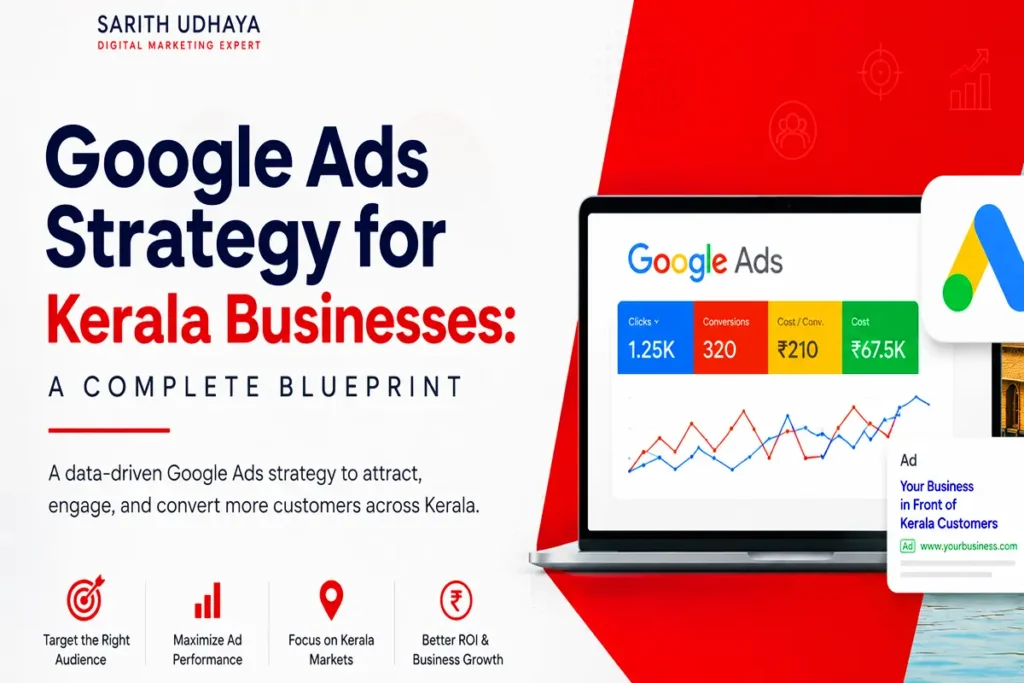
Google Ads also delivers measurable results. Every click, phone call, enquiry, form submission, and purchase can be tracked. This allows businesses to calculate return on investment (ROI), identify high-performing campaigns, and continuously improve performance using real data rather than assumptions.
As AI-powered search continues to evolve, Google Ads has introduced smarter automation, predictive bidding, audience signals, and Performance Max campaigns. Businesses that adopt these features early are better positioned to capture demand across Google Search, YouTube, Maps, Gmail, and the Display Network
Understanding the Kerala Digital Market
Kerala has one of India’s highest internet penetration rates and a digitally active population. Smartphone adoption, affordable mobile data, online banking, and digital payment platforms have transformed how people discover and purchase products and services. Businesses that once depended solely on walk-in customers now receive a large share of enquiries through Google Search.
Kerala’s market is also highly competitive across industries such as healthcare, education, tourism, real estate, finance, legal services, home construction, e-commerce, and professional consulting. Businesses investing in well-structured Google Ads campaigns gain visibility precisely when customers are ready to take action.
Another notable trend is the growing use of regional-language searches. Many users search in Malayalam and English keywords. Businesses that understand multilingual search behaviour and create relevant ad copy can improve engagement and click-through rates while connecting more naturally with local audiences.
Google’s AI-driven advertising ecosystem now evaluates search intent, user behaviour, device type, location, demographics, and browsing history to deliver more relevant ads. Businesses that combine strong keyword research with optimized landing pages, accurate conversion tracking, and AI-powered bidding strategies achieve better performance than those relying solely on manual campaign management.
Building a Winning Google Ads Strategy
Running Google Ads without a clear strategy is like driving to an unfamiliar destination without a map. Many businesses in Kerala start campaigns expecting immediate results, but their budget quickly disappears when they get very few leads. A successful Google Ads strategy starts by defining measurable business goals. Ask yourself what you want to achieve. Are you trying to generate phone calls, increase online sales, collect inquiries, book appointments, or drive more foot traffic to your physical location? Each campaign should have a specific goal, as Google’s AI uses conversion data to optimize performance.
Audience research is equally important. Kerala has a diverse consumer segment with cities like Kochi, Kozhikode, Thrissur, Kannur, Thiruvananthapuram, Kollam, and Kottayam. Understanding age ranges, income levels, interests, occupations, languages, and online behavior allows advertisers to create highly relevant campaigns.
Competitor analysis should also be part of your planning process. Study which businesses consistently appear at the top of Google Ads results by searching for your primary keywords. Analyze their headlines, descriptions, offers, landing pages, extensions, pricing, and calls to action. The goal is not to copy competitors, but to identify opportunities where your business can provide strong value, clear messaging, or a better customer experience.
Your campaign structure should be structured from the start. Separate campaigns by service category, location, or business objective. Within each campaign, group similar keywords into tightly themed ad groups. This structure improves Quality Score, increases ad relevance, and makes ongoing optimization significantly easier. Businesses with well-structured campaigns typically experience better click-through rates and lower costs per click over time.
Keyword Research Strategy
Keyword research forms the foundation of every profitable Google Ads campaign. Choosing the wrong keywords often leads to wasted advertising spend, irrelevant traffic, and poor conversion rates. Instead of targeting broad, high-competition phrases, Kerala businesses should focus on keywords that demonstrate clear commercial intent and local relevance.
Location modifiers play a crucial role in local advertising. Including city names, districts, and regional identifiers can improve ad relevance while reducing competition.
Long-tail keywords deserve special attention. Although they generate lower search volume individually, they usually attract highly qualified prospects. Long-tail keywords also tend to have lower competition and a more cost-effective cost per click.
Negative keywords are another essential component of keyword strategy. Regularly reviewing the Search Terms Report helps identify additional negative keywords, improving campaign efficiency and reducing unnecessary spending.
Choosing the Right Google Ads Campaign Types
Google Ads offers multiple campaign formats, each designed for different business objectives. Selecting the right campaign type depends on your goals, target audience, budget, and customer journey.
Goal
Lead Generation |
Ecommerce Sales |
Brand Awareness |
Website Traffic |
Retargeting |
Product Launch |
App Promotion |
Recommended Campaign
Search |
Performance Max + Shopping |
Demand Gen |
Search |
Performance Max or Demand Gen |
Demand Gen + Video |
App Campaign |
Search Campaigns
Search campaigns remain the most effective option for businesses targeting customers with immediate purchase intent. Appearing at the top of these search results dramatically increases the chances of receiving qualified enquiries.
Well-written search ads should include the target keyword in the headline, highlight a unique selling proposition, and feature a strong call to action. Ad extensions such as call buttons, sitelinks, structured snippets, location extensions, and callout extensions improve visibility while providing additional information to potential customers. Businesses that consistently test multiple ad variations often achieve higher click-through rates and improved Quality Scores.
Performance Max Campaigns
Performance Max has become one of Google’s most powerful AI-driven campaign types. Instead of manually managing separate campaigns for Search, Display, Gmail, Discover, YouTube, and Maps, advertisers provide creative assets, audience signals, and conversion goals while Google’s machine learning optimizes placements automatically.
For Kerala businesses, Performance Max can be particularly valuable when combined with accurate conversion tracking. Retail stores, educational institutions, healthcare providers, tourism companies, and real estate agencies often benefit from broader cross-channel visibility. However, Performance Max should complement—not replace—a well-optimized Search campaign for businesses relying heavily on high-intent searches.
Shopping Ads
Shopping Ads are a type of Google Ads campaign that allows retailers to showcase their products directly in Google Search with product images, prices, store names, ratings, and promotional information. Unlike traditional text ads, Shopping Ads give potential customers a visual preview of your products before they click, helping attract high-intent shoppers who are ready to buy.
Shopping Ads are ideal for eCommerce businesses selling physical products online.
How Do Shopping Ads Work?
Shopping Ads use product information from your Google Merchant Center account instead of keywords alone. You upload a product feed containing details such as product titles, descriptions, prices, images, availability, and shipping information. Google matches this data with relevant user searches and displays your products in Shopping results.
The basic process is:
- Create a Google Merchant Center account.
- Upload and maintain your product feed.
- Link Merchant Center to your Google Ads account.
- Create a Shopping or Performance Max campaign.
Google displays your products to shoppers searching for related items.
Where Do Shopping Ads Appear?
Shopping Ads can appear across several Google properties, including:
- Google Shopping tab
- Google Search results
- Google Images
- YouTube (through Performance Max)
- Google Display Network (through Performance Max)
- Gmail (through Performance Max)
- Google Discover (through Performance Max)
- The exact placements depend on the campaign type and your settings.
Benefits of Shopping Ads
Higher Purchase Intent
Shopping Ads reach users who are actively looking to buy products.
Better Click Quality
Because users can see the product and price before clicking, traffic is often more qualified.
Increased Visibility
Products can appear at the top of search results with eye-catching visuals.
Higher Conversion Rates
Pre-qualified shoppers are generally more likely to complete a purchase.
Scalable Advertising
Whether you sell 20 products or 20,000, Shopping Ads can promote your catalog efficiently.
Demand Gen Campaign
A Demand Gen campaign is an AI-powered Google Ads campaign designed to help businesses create demand, build brand awareness, and inspire potential customers before they actively search for a product or service. Instead of targeting only users with high purchase intent, Demand Gen reaches people who are discovering new brands and products through visually engaging ads.
Unlike Search campaigns, which capture existing demand, Demand Gen focuses on generating interest earlier in the customer journey.
How Does Demand Gen Work?
Google uses machine learning and audience signals to identify people who are most likely to engage with your business.
The process typically works like this:
Upload high-quality images or videos.
Add headlines, descriptions, logos, and a call-to-action.
Select your campaign objective (such as sales, leads, or website traffic).
Define your audience using:
Customer lists
Website visitors
Custom segments
Lookalike-style audience expansion
Google’s optimized targeting
Google automatically serves your ads across eligible placements to maximize performance.
YouTube Ads
YouTube Ads are video advertisements that appear on YouTube and across Google’s video partner network. They allow businesses to reach potential customers through engaging video content at different stages of the buying journey—from building brand awareness to driving sales and leads.
As the world’s largest video platform, YouTube gives advertisers access to billions of monthly users, making it one of the most effective channels for visual storytelling and customer engagement.
How Do YouTube Ads Work?
YouTube Ads are managed through Google Ads. After creating a campaign, you upload or link a YouTube video, define your target audience, set your budget, and choose a bidding strategy. Google then uses its AI to deliver your ads to users who are most likely to engage or convert.
Advertisers can target audiences based on:
- Demographics (age, gender, location, language)
- Interests and hobbies
- Search behavior
- Custom audience segments
- Customer Match lists
- Website visitors (remarketing)
Where Do YouTube Ads Appear?
YouTube Ads can appear in several places, including:
- Before, during, or after YouTube videos
- YouTube Shorts
- YouTube Home Feed
- YouTube Search Results
- Watch Next recommendations
- Google video partner websites and apps (if enabled)
Types of YouTube Ads
- Skippable In-Stream Ads
These ads play before, during, or after a video and can usually be skipped after five seconds.
Best For:
- Brand awareness
- Website traffic
- Lead generation
- Product promotions
- Non-Skippable In-Stream Ads
These short ads (typically up to 15 seconds) must be watched before the main video continues.
Best For:
- Brand awareness
- Product launches
- High-impact messaging
- In-Feed Video Ads
These ads appear in YouTube Search results, the Home feed, and the Watch Next section. Users choose to click and watch the video.
Best For:
- Educational content
- Tutorials
- Product reviews
- Long-form marketing videos
- YouTube Shorts Ads
Vertical video ads are displayed between YouTube Shorts.
Best For:
- Mobile-first audiences
- Quick promotions
- Brand awareness
- Social-style content
- Bumper Ads
Short, non-skippable ads lasting up to six seconds.
Best For:
- Brand recall
- Product reminders
- Large-scale awareness campaigns
Benefits of YouTube Ads
Massive Audience Reach
Reach billions of users across YouTube and Google’s video network.
Highly Engaging Content
Video captures attention better than text or static images, making it easier to explain products and services.
Advanced Audience Targeting
Target users based on interests, behavior, search activity, demographics, and remarketing lists.
AI-Powered Optimization
Google automatically optimizes ad delivery and bidding to improve campaign performance.
Flexible Budgets
You can start with a small daily budget and scale as your campaigns become profitable.
Detailed Performance Insights
Track key metrics such as:
- Views
- Watch time
- View rate
- Click-through rate (CTR)
- Conversions
- Cost per view (CPV)
- Return on ad spend (ROAS)
Best Use Cases for YouTube Ads
YouTube Ads are ideal for:
- Building brand awareness
- Launching new products or services
- Explaining complex products
- Demonstrating product features
- Generating leads
- Driving website traffic
- Increasing online sales
- Retargeting previous website visitors
Budget Planning for Google Ads
One of the biggest misconceptions among Kerala business owners is that Google Ads requires a massive advertising budget to generate meaningful results. In reality, success depends far more on strategic budget allocation than on the total amount spent. A carefully planned campaign with a modest daily budget can outperform a poorly managed campaign that spends several times more. The objective should always be to maximize Return on Ad Spend (ROAS) and generate high-quality leads rather than simply increasing clicks.
Smart Bidding Strategies
Google’s machine learning has transformed how advertisers manage bids. Instead of manually adjusting keyword bids throughout the day, Smart Bidding uses real-time signals.
Selecting the right bidding strategy depends on your campaign objective. Businesses aiming to maximize website enquiries often benefit from Maximize Conversions, while companies with sufficient conversion history can transition to Target CPA (Cost Per Acquisition) to maintain predictable lead costs. E-commerce businesses frequently use Target ROAS, allowing Google to prioritize sales that generate the highest revenue relative to advertising spend.
Manual CPC still has value for newly launched campaigns where conversion data is limited. During the initial learning phase, manual bidding provides greater control while Google gathers enough information to support automated optimization.
Landing Page Optimization
Even the most successful Google Ads campaign can fail if users arrive on a poorly designed landing page. Generating clicks is only half the process—the landing page must persuade visitors to take action. Every element should reinforce the promise made in the advertisement and guide users toward a clear conversion goal.
A high-performing landing page typically includes persuasive headlines, concise benefit-focused copy, customer testimonials, trust signals such as certifications or awards, service highlights, frequently asked questions, and a prominent enquiry form or phone number. Visual hierarchy also matters. Important information should appear above the fold, allowing users to understand the offer without excessive scrolling.
Conversion Tracking
Running Google Ads without conversion tracking is similar to managing a business without accounting records—you know money is being spent, but you cannot accurately measure results. Conversion tracking provides the data needed to evaluate campaign effectiveness, identify profitable keywords, and optimize advertising performance.
Businesses should track every meaningful customer action. These may include contact form submissions, phone calls, WhatsApp enquiries, appointment bookings, online purchases, brochure downloads, newsletter sign-ups, or live chat interactions. Importing offline conversions—such as leads that later become paying customers—provides an even more accurate picture of campaign profitability.
AI and Automation in Google Ads
Artificial intelligence now influences nearly every aspect of Google Ads. Modern campaigns rely on machine learning to optimize bidding, generate audience insights, recommend ad combinations, predict conversion probability, and allocate budgets across Google’s advertising ecosystem. Businesses that embrace these capabilities often gain a competitive advantage while reducing manual workload.
Measuring ROI and Campaign Success
Launching Google Ads campaigns is only the beginning. Long-term success depends on consistently measuring performance and refining strategy based on measurable outcomes. Instead of focusing solely on impressions or clicks, businesses should prioritize metrics directly connected to revenue and profitability.
Key performance indicators include Click-Through Rate (CTR), Conversion Rate, Cost Per Click (CPC), Cost Per Acquisition (CPA), Return on Ad Spend (ROAS), Quality Score, Impression Share, and Customer Lifetime Value (CLV). Together, these metrics provide a comprehensive view of campaign health and profitability.
Common Google Ads Mistakes Kerala Businesses Should Avoid
One of the most common errors is targeting overly broad keywords. Broad match terms often attract irrelevant searches, increasing costs without generating qualified leads. Careful keyword selection combined with comprehensive negative keyword lists significantly improves efficiency.
Another frequent mistake is sending all advertisement traffic to the homepage. Generic landing pages rarely match user intent, resulting in lower conversion rates and higher bounce rates.
Additional mistakes include neglecting mobile optimization, ignoring Search Terms Reports, failing to test multiple ad variations, making constant bid adjustments during the learning phase, and pausing campaigns too quickly before sufficient data has been collected. Google Ads rewards consistency, continuous optimization, and data-driven decision-making.
FAQ
The best Google Ads strategy for Kerala businesses focuses on targeting the right audience with high-intent keywords, location-based targeting, optimized landing pages, and accurate conversion tracking.
The required Google Ads budget in Kerala depends on factors such as industry competition, target location, keyword cost, business goals, and expected lead volume.
Kerala consumers increasingly use Google Search to find products, services, and local businesses. Google Ads allows businesses to appear in front of potential customers when they are actively searching for solutions.
Google Ads can generate immediate visibility and traffic once campaigns are approved and active. However, achieving consistent and profitable results usually requires continuous optimization over several weeks or months.
- Click-Through Rate (CTR): Measures how effectively ads attract user attention.
- Conversion Rate: Shows how many visitors complete a desired action.
- Cost Per Acquisition (CPA): Calculates the cost of generating a customer or lead.
- Return on Ad Spend (ROAS): Measures revenue generated from advertising investment.
- Quality Score: Indicates Google’s evaluation of keyword relevance, ads, and landing pages.
Conclusion
Google Ads is no longer just a paid advertising platform; it has become a powerful customer acquisition system that helps Kerala businesses connect with high-intent customers at the exact moment they are searching for solutions. From local service providers and startups to established companies, businesses that implement a data-driven Google Ads strategy in Kerala can achieve better visibility, generate qualified leads, and improve revenue growth in a competitive digital marketplace.
However, successful Google Ads campaigns require more than simply creating advertisements and increasing budgets. A profitable campaign depends on advanced keyword research, search intent analysis, audience segmentation, competitor insights, conversion tracking, landing page optimization, smart bidding strategies, and continuous performance improvements. Every click should have a purpose, and every marketing decision should be supported by accurate data.
Working with a Google Ads Expert in Kerala helps businesses avoid common advertising mistakes such as targeting irrelevant keywords, wasting budget on low-quality traffic, poor campaign structures, and incorrect conversion tracking. An experienced Google Ads professional understands Kerala’s local search behaviour, regional customer patterns, industry competition, and market trends, allowing businesses to create campaigns that attract the right audience and generate measurable business outcomes.

Sarith Udhaya is a Google, Hubspot, SEMrush, and Bing-certified Freelance SEO Expert based in Calicut, Kerala. He has mastered creating successful SEO marketing strategies for all types of businesses using his 6+ years of experience in digital marketing.
From SEO and Google Ads to YouTube optimization and complete digital marketing, Sarith Udhaya works closely with clients to understand their goals and achieve sustainable growth.
His broad industry knowledge, receptiveness, and relentless commitment to outcomes have earned him clients’ trust throughout Kerala. He has helped countless businesses find their digital voice, ensuring they rank well, attract the right customers, and grow steadily. Sarith Udhaya approach is simple – understand your story, translate it into a digital strategy, and ensure the world finds you online.
Ready to grow your business with Google Ads?
Launch data-driven Google Ads campaigns designed to attract the right audience and grow your business.