
What Is Topical Authority in SEO
Topical authority is an SEO strategy where a website becomes a trusted source on a specific subject by publishing comprehensive, accurate, and interconnected content that covers the topic in depth. It helps search engines understand expertise, improves rankings for related keywords, and increases visibility in Google AI Overviews.
Why Does Topical Authority Matter in 2026
In 2026, search engines no longer rank pages based only on keywords. Google uses advanced AI, semantic search, entity recognition, and user intent analysis to identify websites that provide the most complete and trustworthy information on a topic.
Understanding Topical Authority
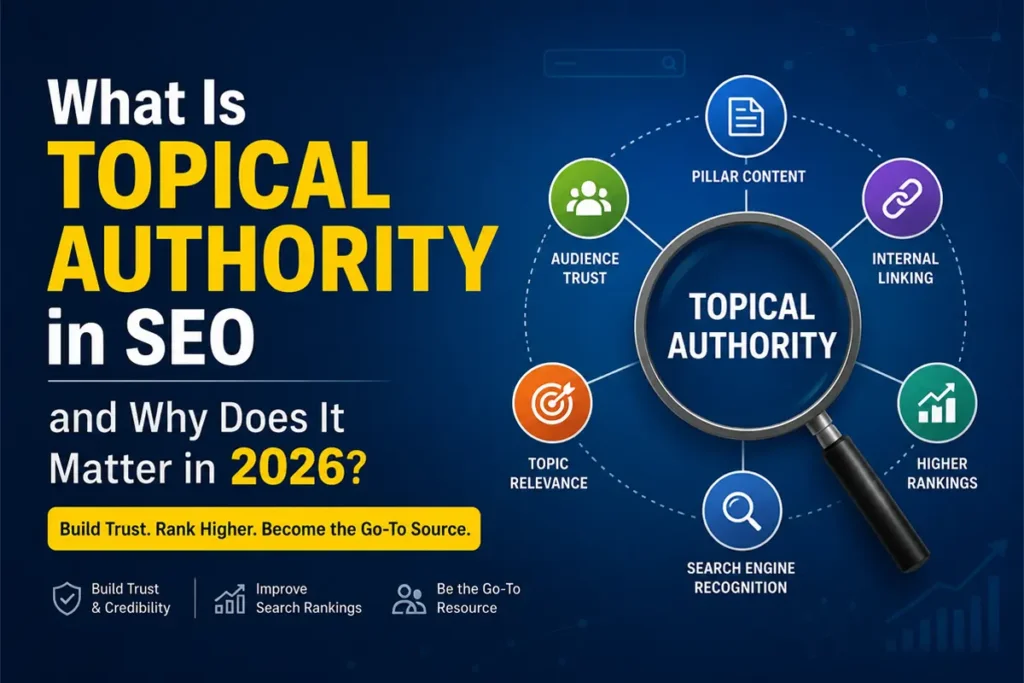
Topical authority is the level of expertise and trust a website demonstrates about a particular subject through its content. Rather than focusing on isolated keywords, topical authority is built by creating a comprehensive collection of high-quality articles that answer every important question users may have about a topic.
Google’s systems analyze relationships between pages, entities, search intent, internal links, content depth, freshness, and user satisfaction. When your content consistently answers users’ questions better than competitors, search engines begin recognizing your website as an authority on that subject. This creates a positive feedback loop where new articles can rank more easily because the overall domain has already established expertise.
Why Topical Authority Is Essential for SEO in 2026
The Rise of AI Search
Search behavior is changing rapidly. Google AI Overviews, ChatGPT, Perplexity, Gemini, and other AI-powered search tools increasingly generate answers instead of merely listing web pages. This means websites are competing not only for traditional rankings but also for citations inside AI-generated responses. Industry research shows authoritative websites covering subjects in depth are significantly more likely to appear in AI-generated answers because these systems prioritize trustworthy and comprehensive sources.
Instead of rewarding isolated articles, AI systems evaluate the overall credibility of a website. Consistency, factual accuracy, original insights, and complete topical coverage all contribute to becoming a preferred source.
Google's Focus on Expertise
Google has steadily evolved from keyword matching to semantic understanding. Algorithm improvements such as Hummingbird, RankBrain, BERT, MUM, and continuing AI-driven advancements have improved Google’s ability to recognize expertise rather than keyword repetition. Google’s quality systems increasingly evaluate whether content demonstrates genuine experience and satisfies user intent comprehensively.
Topical Authority vs Domain Authority
Many website owners confuse topical authority with domain authority. While domain authority is a third-party metric estimating backlink strength, topical authority is a broader concept describing how comprehensively your website covers a subject. A relatively small niche website can outrank much larger competitors simply because it demonstrates stronger topical expertise.
Topical Authority vs Domain Authority
Feature
|
Focus |
|
Measured by Google |
|
Built Through |
|
Best For |
Topical Authority
|
Expertise in one topic |
|
Indirectly |
|
Comprehensive content |
|
Sustainable rankings |
Domain Authority
|
Overall backlink strength |
|
No official metric |
|
Backlinks |
|
Competitive comparisons |
Topical Authority vs Traditional Keyword SEO
Traditional Keyword SEO focuses on optimizing individual pages for specific keywords to improve rankings for those exact search terms. While this approach can generate traffic, it often creates isolated content that lacks depth and broader context.
Topical Authority SEO, on the other hand, focuses on covering an entire subject through comprehensive, interconnected content that answers every relevant user question. By building topic clusters, using semantic keywords, and strengthening internal links, websites demonstrate expertise and become trusted resources for both users and search engines.
In 2026, Google and AI-powered search systems increasingly reward websites with strong topical authority because they provide complete, relevant, and trustworthy information rather than simply targeting individual keywords.
Feature
|
Focus |
|
Goal |
|
Strategy |
|
Content |
|
Internal Links |
|
Long-Term Growth |
|
AI Search Readiness |
Traditional SEO
|
Individual keywords |
|
Rank one page |
|
Keyword optimization |
|
Standalone articles |
|
Limited |
|
Moderate |
|
Low |
Topical Authority SEO
|
Complete topics |
|
Rank entire website |
|
Topic clusters |
|
Connected content ecosystem |
|
Extensive |
|
High |
|
Excellent |
How to Build Topical Authority
Building topical authority requires a structured content strategy rather than random publishing. The process begins with identifying your core topic and then expanding into every relevant subtopic your audience might search for.
Create Pillar Content
A pillar page acts as the foundation of your topic. It provides a broad overview while linking to detailed supporting articles. For example, a pillar page titled “Complete Guide to SEO” can link to individual articles covering technical SEO, keyword research, local SEO, AI SEO, content optimization, link building, and analytics.
Build Topic Clusters
Each supporting article should explore one specific aspect in depth. Together, these articles form a topic cluster that signals expertise. Instead of writing unrelated posts, every article contributes to your overall authority.
Strengthen Internal Linking
Internal links connect your content ecosystem. Every relevant article should naturally reference related guides, helping both users and search engines discover additional information. Strong internal linking distributes authority across your website and improves crawl efficiency.
Demonstrate E-E-A-T
Google values Experience, Expertise, Authoritativeness, and Trustworthiness (E-E-A-T). Include real case studies, expert insights, author profiles, original images, research, and updated information. Websites that demonstrate practical experience tend to earn greater trust from both users and search engines.
Common Mistakes That Prevent Topical Authority
Many websites struggle because they publish content without a clear strategy. One common mistake is writing about too many unrelated topics. A website covering SEO today, recipes tomorrow, cryptocurrency next week, and travel afterward sends mixed signals about its expertise.
Another issue is poor internal linking. Even excellent articles lose value if they remain isolated. Search engines need contextual relationships to understand topic clusters.
Thin content is equally problematic. Publishing dozens of 300-word articles rarely builds authority. Comprehensive, well-researched content consistently performs better because it satisfies user intent more effectively.
Ignoring updates is another frequent mistake. Industries evolve rapidly, especially SEO. Outdated information weakens credibility and may reduce rankings over time.
Measuring Topical Authority Success
Although Google does not publish an official topical authority score, you can evaluate progress using several SEO metrics.
Monitor the number of keywords ranking in the top 10, organic traffic growth, impressions in Google Search Console, click-through rates, average engagement time, pages per session, and conversions. Increasing visibility across hundreds of related keywords often indicates growing topical authority.
Another useful indicator is whether new articles begin ranking faster than older ones. As your authority grows, Google tends to trust newly published content more quickly because your website has already established expertise.
Backlink quality also matters. When industry websites naturally reference your content, it reinforces authority and improves overall trust.
FAQ
Build topical authority by selecting a core topic, identifying related subtopics, creating high-quality content for each topic, and connecting relevant pages through strategic internal links.
A topical authority map is a structured plan showing the main topic, supporting subtopics, related questions, entities, and content relationships a website should cover.
Topical authority can improve a website’s ability to rank by demonstrating strong relevance and comprehensive coverage of a subject
There is no fixed number of articles required to establish topical authority. The number depends on the complexity and breadth of the subject.
Strong topical coverage can improve a website’s ability to be understood and considered as a relevant source for AI-powered search experiences.
A pillar page is a comprehensive page covering a broad core topic. It connects to more specific supporting articles that explain related subtopics in greater detail.
A topical cluster is a group of interconnected pages covering a central topic and its related subtopics. Typically, a pillar page provides broad coverage while cluster pages answer specific questions or address narrower aspects of the main subject.
Conclusion
Topical Authority is no longer an optional SEO strategy—it is the foundation of sustainable search visibility in 2026. As Google continues to evolve with AI-powered search, semantic understanding, entity recognition, and AI Overviews, websites that demonstrate genuine expertise across an entire subject consistently outperform those targeting isolated keywords.
Building topical authority means creating a connected ecosystem of valuable content that answers every stage of a user’s journey—from basic questions to advanced, decision-making topics. Combined with strategic internal linking, strong E-E-A-T signals, entity optimization, and regular content updates, this approach helps search engines understand not just what your pages are about, but why your website deserves to be trusted.
Whether you are a business owner, marketer, or aspiring SEO Expert in Kerala, investing in topical authority today will create lasting organic growth, higher-quality leads, and a stronger online presence.
Want to build stronger topical authority and improve your search visibility?

Sarith Udhaya is a Google, Hubspot, SEMrush, and Bing-certified Freelance SEO Expert based in Calicut, Kerala. He has mastered creating successful SEO marketing strategies for all types of businesses using his 6+ years of experience in digital marketing.
From SEO and Google Ads to YouTube optimization and complete digital marketing, Sarith Udhaya works closely with clients to understand their goals and achieve sustainable growth.
His broad industry knowledge, receptiveness, and relentless commitment to outcomes have earned him clients’ trust throughout Kerala. He has helped countless businesses find their digital voice, ensuring they rank well, attract the right customers, and grow steadily. Sarith Udhaya approach is simple – understand your story, translate it into a digital strategy, and ensure the world finds you online.